
Straight Razor Styles
There are various types of blade parameters that define a straight razor. These pertain to width, amount of grind, and the toe or tip end shape. These characteristics may have either practical or aesthetic considerations for the user. No specific geometry is better or worse than any other.
Blade End Types
The blade end, tip, or toe, can have a number of different shapes such as Dutch or round end, square, spike, French or oblique, Spanish, and lastly the barber's notch.
Dutch or Round
This is the most beginner-friendly of all the end shapes. It is rounded into a half circle so there is no sharp angle at the end of the blade. This makes the blade very forgiving and lessens the chance of the user nicking themselves while shaving. The drawback, however minor, is that the razor is not quite as accurate when trying to trim or shape a beard or mustache. It can also make it a bit more difficult cutting up against the ear.
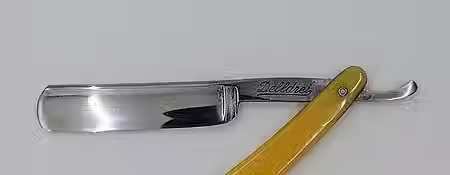
Square
The square end has a 90-degree angle where the cutting edge meets the toe end of the blade. This offers very precise accuracy when cutting and shaping. The drawback here is that the sharp 90 degree angle can nick you if you're not careful. Many honers will slightly round off that 90-degree tip, making it less prone to nicking but still tight enough to do precise shaving.
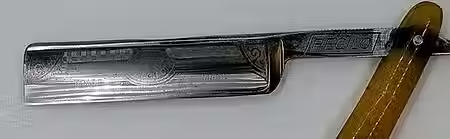
French or Oblique
The French point is between a Dutch point and a square point. It still allows for detailed styling while not being quite as aggressive as a square point.
Spike
This point is the most aggressive of all. The meeting of the cutting edge to the toe end is less than 90 degrees, allowing for very precise shaving, but that smaller angle makes this one the most likely to draw blood.
Spanish
Somewhat between a French and a spike point. It has a slight concave end, almost resembling the barber's notch.
Barber's Notch
This is more of a stylistic geometry, although it does offer some functionality. A notch is cut out of the end of the razor making it easier to open. It was also used to distinguish barber's razors from others. This is the most classic and vintage look and is very popular with wedge and near wedge razors, although it is also seen on the occasional hollow grind blade.

Width
Blade widths, measured from the spine to the cutting edge are usually measured in 1/8" increments. The most common is 5/8. Smaller blades can be 4/8 and work their way to the rather rare 9/8. The smaller the width, the lighter the razor and the more maneuverable it is. The drawback to a smaller width is that it would need to be rinsed more often during a shaving session as the narrower blade can not hold, or scoop, as much shave soap as a wider blade.
Grind
Grinds tend to be wedge, near wedge, quarter hollow, half hollow, full hollow, and extra hollow. This simply refers to how much metal was ground off the side of the razor. A true wedge, which is rather rare, will have no metal ground off and will maintain its triangular cross section.
Grinding off metal will make the part of the blade going towards the cutting edge narrower and more delicate. No particular grind is better than the other. The more hollow ground the razor, the thinner the business end of the blade. This thinness makes the blade a bit more forgiving as the edge has a bit of flex to it.

So What Does All This Mean?
People with heavy facial hair tend to prefer wider blades closer to wedge than hollow, as the added weight can make cutting through heavier stubble a bit easier. The blade has a bit more inertia and tends not to deflect as easily. On the other hand, a lighter blade may not be as intimidating and may be easier to maneuver.
If your are just starting your straight razor journey, a hollow ground 5/8 Dutch point is the most popular, although some feel that the stability of a heavier razor makes it easier to shave with. There are no hard and fast rules here.